
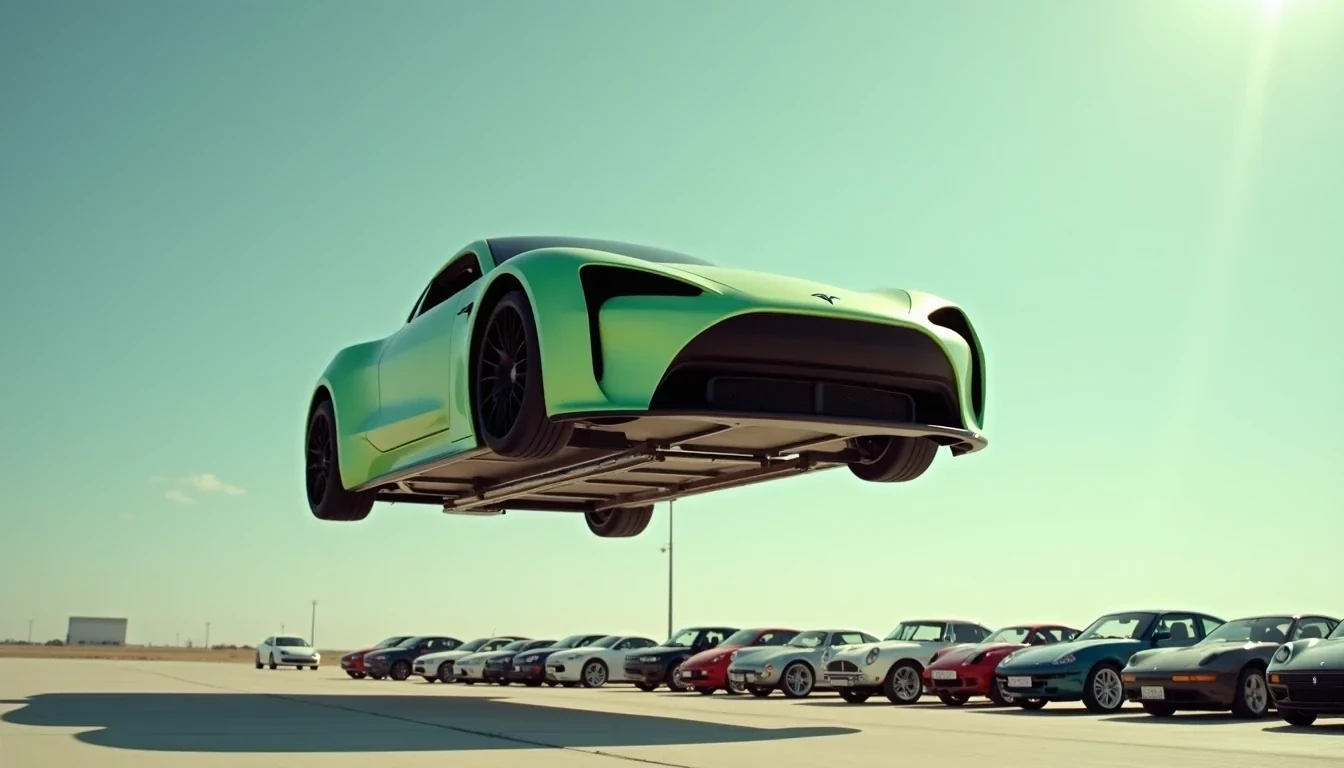
Elon Musk has been selling the future for nearly two decades, and the invoice keeps getting longer. The second-generation Tesla Roadster, first announced in 2017 and now promised for 2028, recently appeared in demonstration footage clearing rows of parked vehicles in mid-air, completing rolls and flips, and landing with implausible softness. The base model is claimed to hit 0–60 mph in under 1.6 seconds. The “Thrust” variant, equipped with cold-gas thrusters, is said to manage 0.81–0.85 seconds. Top speed exceeds 230 mph. Range stretches from 300 to 620 miles depending on configuration. An underbody suction fan supposedly generates over 2 g of cornering grip, enough to drive inverted on curved tracks. Three variants exist: a $50,000-deposit Performance model, a $250,000-deposit Thrust, and an invite-only Rocket single-seater that is not road-legal. The October 2026 reveal showed all of this in action. The physics on display does not match the physics required.
How the Flying Illusion Probably Worked
The footage carries several visual signatures of practical effects work rather than genuine flight. No thruster plumes are visible despite claims of rocket-style cold-gas systems producing enough force to lift a multi-ton vehicle. No dust, debris, or ground disturbance accompanies the launches. The landing dynamics look pre-programmed, lacking the suspension compression and rebound that even a thruster-assisted descent would produce. The trajectory is rigidly smooth, suggesting a fixed ramp path rather than real-time altitude and roll correction. The vehicle’s apparent mass seems to disappear during the leap, which is difficult to reconcile with cold-gas thrusters that typically offer low thrust-to-weight ratios for terrestrial applications.
These observations point toward a shell mounted on a hidden cart or launch mechanism, a technique that predates computer-generated imagery by decades. The body of the Roadster, stripped of drivetrain and battery mass, could be propelled along a concealed track or ramp system with far less energy than genuine flight would demand. Camera angles and editing complete the illusion by keeping the support structure out of frame.
The Knight Rider Precedent
This is not a new trick. Television productions in the 1970s and 1980s refined the art of making cars appear to do impossible things. Knight Rider regularly launched KITT over obstacles using hidden ramps, pneumatic cannons, and lightweight “buck” vehicles, fiberglass shells with no functional internals that could survive repeated abuse. Reinforced stunt chassis handled jumps where the actual vehicle was involved. Cranes and nearly invisible wire rigs provided slower, more controlled suspension effects. Clever camera placement and rapid cutting ensured the audience never saw the machinery behind the magic.
The Roadster demonstration follows the same playbook with higher production values. Knight Rider never asked viewers to place deposits on the promise that their own car would eventually turbo-boost over a semi-truck. Tesla has collected reservation money since 2017 on a vehicle that has now missed multiple production targets, with the current 2028 date looking increasingly speculative.
Why Cold-Gas Thrusters Do Not Work This Way
The engineering claims deserve separate scrutiny. Cold-gas thrusters, typically using compressed nitrogen or carbon dioxide, offer low specific impulse compared to chemical propulsion. Lifting a vehicle of the Roadster’s mass for even brief airborne leaps would require enormous volumes of high-pressure gas stored in massive, heavy tanks. Those tanks would consume the interior space and payload capacity needed for the vehicle to function as a car.
Thrust-to-weight ratios present a deeper problem. Generating sufficient force to overcome gravity, plus providing controlled altitude, pitch, roll, and yaw authority, demands substantial nozzle arrays and sophisticated flight control computers with real-time sensor fusion. The safety redundancy required for any airborne vehicle, where thruster failure or propellant leak means catastrophic descent, adds further weight and complexity. A vehicle capable of controlled flight would fall under aviation authority certification, requiring airworthiness standards, pilot licensing, and air traffic control integration. The invite-only Rocket variant, explicitly not road-legal, hints at regulatory realities that the more mass-market variants conveniently ignore.
The Pattern of Promises
The Roadster is not an isolated case. Musk’s product demonstrations have repeatedly blurred the line between aspiration and actual capability. The 2019 Cybertruck window smash, the repeatedly deferred Full Self-Driving timeline, the Optimus robot hand-waved on stage by a person in a suit before any working prototype existed. Each event generates headlines, deposits, and stock movement. Each leaves the actual product years away from the demonstrated moment, if it arrives at all.
The specific allegation here, captured in the circulating caption, asks how many times the same audience can be deceived before recognising a pattern. That framing is harsh, but it has structural support. The demonstration footage shows a vehicle doing things that the claimed propulsion system cannot physically accomplish in the manner presented. The alternative explanation, a shell on a cart, accounts for every visual anomaly and requires no technological breakthroughs.
What This Means for Technical Trust
For practitioners who build and ship actual systems, the Roadster spectacle carries a particular sting. The gap between demo and deployment is a familiar failure mode in software and hardware engineering. Every developer has watched a slick prototype crumble under real load, every integrator has untangled a vendor’s polished presentation to find missing API endpoints and placeholder functionality. Most technical practitioners do not charge $50,000 deposits against a video of something that probably cannot exist as shown.
The working standard should be reproducible results under observed conditions, not carefully staged performances with obscured mechanics. Tesla could have demonstrated the cold-gas thrusters on a test rig, shown measured thrust output, published propellant consumption rates, or invited independent verification of the flight dynamics. It chose cinematic presentation instead. That choice reveals which audience the company is actually addressing, and it is not engineers.
Consumer trust in technical claims erodes industry-wide when the most visible demonstrations turn out to be stagecraft. The next startup with a genuine aerodynamic or propulsion breakthrough will face steeper skepticism because of these theatrics. The burden of proof shifts onto honest actors, while the reward structure still favours those willing to blur the line.
For anyone evaluating technology investments, whether $250,000 deposits or integration partnerships, the Roadster episode offers a usable filter. Ask what was not shown. Ask why the camera angle excludes the undercarriage. Ask whether the demonstrated capability has been repeated outside controlled conditions. The absence of answers is itself information, and it costs nothing to collect.